SCUBA TANK TO AIR GUN TANK FILL CALCULATOR
Back to the Calculator.
EQUIPMENT & ENVIRONMENT INPUT DESCRIPTION
Scuba tank volume/capacityEnter the scuba tank volume or capacity. See under TANK MEASUREMENT for description of volume vs. capacity.
Scuba tank maximum rated service pressureEnter the maximum rated service pressure of the scuba tank.
Gun tank volume/capacityEnter the gun tank volume or capacity. See under TANK MEASUREMENT for description of volume vs. capacity.
Gun tank maximum rated service pressureEnter the maximum rated service pressure of the gun tank.
Fill kit volumeEnter the internal volume of the fill kit. This is the air that you bleed out before disconnecting the gun tank.
TemperatureEnter the temperature of the air in the scuba tank.
INPUT DESCRIPTION
Scuba tank current pressureEnter the scuba tanks current pressure. You might have a scuba tank with a maximum rated service pressure on 4500PSI, but have only been able to get it filled to 3000PSI. Then enter 3000PSI.
Gun tank maximum pressureEnter the maximum pressure of the gun tank. You might have a gun tank with a maximum rated service pressure on 3000PSI, but only want to fill it to 2500PSI. Then enter 2500PSI.
Gun tank minimum pressureEnter the gun tank minimum pressure. This is the lowest pressure you want in the gun tank. Normally when muzzle velocity starts to drop, and you want to refill.
Gun tank initial pressureEnter the pressure of the gun tank, before you start first fill. If the gun tank is empty, enter 1 Bar. 1 Bar is the pressure we have on an average day.
TANK MEASUREMENT
CapacityCapacity is the amount of air a tank will hold at its maximum rated service pressure. Capacity is the default measurement of scuba tanks in the US, and is normally measured in cubic feet.
VolumeVolume is the internal dimensions of a tank, also known as water capacity. Volume is the default measurement of scuba tanks in Europe, and normally measured in liters or cubic centimeter.
INPUT RANGES
Volume/CapacityThe input range for volume and capacity if from 0 and up. It is measured in Liter, Cubic Centimeter and Cubic Feet.
PressureThe pressure input range is from 0 to 500 BAR and 0 to 7250 PSI.
TemperatureThe temperature input range is from -93 to 126 Celsius, -135 to 260 Fahrenheit and 180 to 400 Kelvin.
CALCULATION AND RESULTS
Realistic resultTo calculate results, this calculator uses the specific compressibility factor of dry atmospheric air, for the given pressure and temperature. This will give a much more realistic result than other calculators not using this factor. To my knowledge there are no other online calculators that can do this.
Temperature,
Pressure, and
Compressibility Factor
To calculate the content of air in any pressurized tank, including scuba tanks and air gun tanks, we only need to know the volume of the tank and the pressure. The equation look like this:

(volume in liter * pressure in BAR) = content in liter

Unfortunately air does not quite follow this simple equation. Especially when dealing with pressure as high as 200 BAR (3000 PSI) or above. In general, when using this equation, the higher the pressure gets, the more inaccurate the result gets. That's why we need to add the compressibility factor of air, to the equation, which will give us a much more realistic result. The equation then look like this:

(volume in liter * pressure in BAR) / compressibility factor = content in liter

The compressibility factor of air is a way of describing how much air "resists" being compressed at a given pressure and temperature. So in order to find the compressibility factor of air we only need to know one more thing: the temperature.

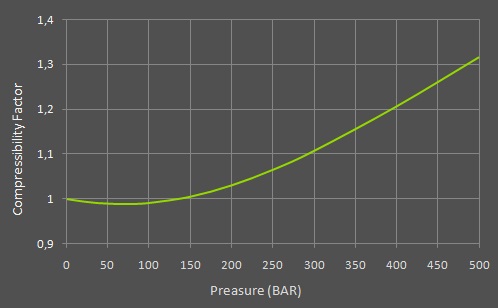
The green line in the graph below, shows the compressibility factor of dry atmospheric air at 25°C from 0 to 500 BAR.

The need for compressibility factor is probably best visualized using a small example:

Let's say we have a tank with an internal volume of 1 liter (1000cc). We fill this tank to 1 BAR, and use the equation without the compressibility factor, to calculate the content. It will look like this:

(1 liter * 1 BAR) = 1 liter

Very simple, 1 liter of air in the tank. We fill the tank to 2 BAR and we will have: (1 liter * 2 BAR) = 2 liters of air in the tank. 3 BAR = 3 liters, 100 BAR = 100 liters, 300 BAR = 300 liters and so on.

Now let's try and calculate the content of air, in the same small tank, using the equation with the added compressibility factor of air. We'll fill it to 300 BAR again, on a nice warm day with a temperature of 25°C (77°F). First we need to find the specific compressibility factor of air for 300 BAR in the graph above, which is 1.1074. We then add this factor to the equation, and our calculation will look like this:

(1 liter * 300 BAR) / 1.1074 = 270.9 liters

Calculating the content without the compressibility factor, we would have gotten 300 liters. So what happened to the remaining 29.1 liters of air? Well, the 29.1 liters just never got into the tank before the pressure reached 300 BAR. This is because air with a temperature on 25°C at 300 BAR "resists" being compressed that much more. Making us reach 300 BAR of pressure, 29.1 liters of air short, so to speak.

29.1 liters might not sound of much, but remember that this is a tank with a volume on only 1 liter.
If we do the same calculation with a quite common scuba tank, with a 12 liter volume filled to 300 BAR (4351 PSI), we would see that almost 350 liters would be "missing", compared to not using the compressibility factor when calculating the content.
350 liters of air could easily be worth as much as 30 refills of an air gun, depending of the needed pressure and tank size. So do yourself a favor, and make a few calculations before buying a scuba tank for your air gun - So you know what you can expect.
Back to the Calculator.